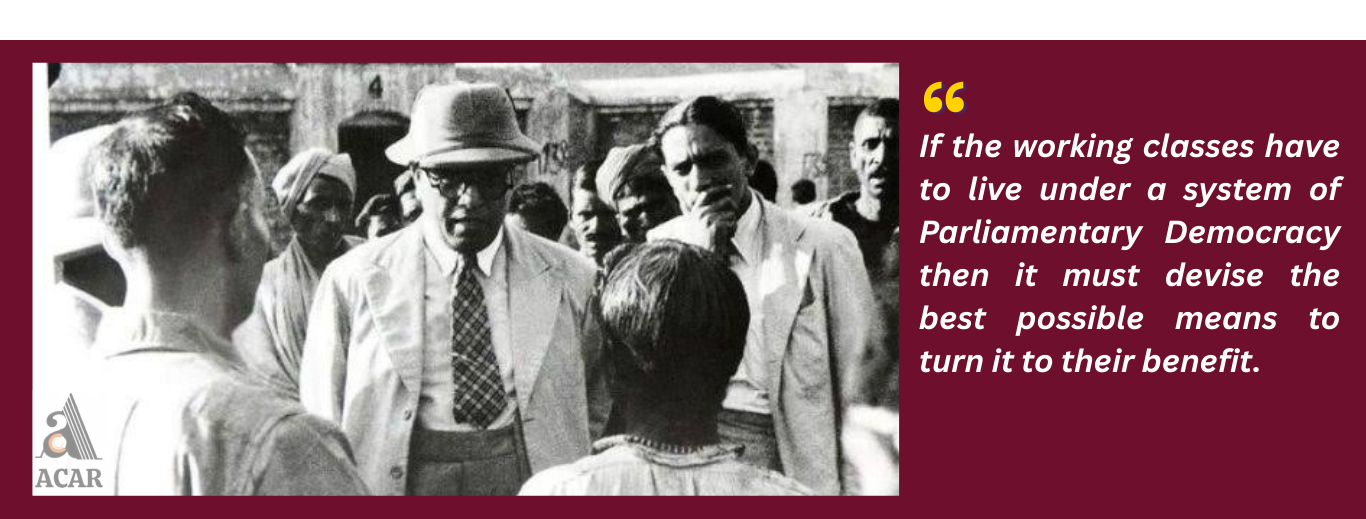
Ambedkar: Labour Minister

Labour Codes: Uniformity without Democracy?

The new Labour Codes are portrayed as a landmark, by the Industry and federations applauding it for legal “uniformity” and “simplification” for ease of doing business. However, when compared to Babasaheb Ambedkar’s labor vision as a Labour Member (1942–46), fall short in crucial ways as Valerian Rodrigues bonds it with Deweyan Industrial democracy, Fabian welfare and Buddhist ethics of equality (2024). Babasaheb Ambedkar sought more than just uniform legislation, Industrial democracy, social security, and a permanent, tripartite machinery to make labor a partner in national governance rather than just a regulated subject. In contrast, the new Labour Codes allows industry to fire upto 300 workers, restrain strikes, ignore unions and put workforce for 12 hour shifts.

Labour Code vs Conference

Ambedkar’s interventions in labor policy, as exemplified in tenth volume of Babasaheb Ambedkar’s writings and speeches focused on three interconnected objectives: uniform labor laws that guarantee workers, regardless of region, shared a minimum level of rights and protections, a central, precise method for resolving labor disputes, and a platform for all of India to discuss “all matters relating to employers and employees that are of national importance,” institutionalized in the form of a permanent Labour Conference and a Standing Labour (Advisory) Committee. The Labour Conference and Standing Committee were designed as permanent, representative bodies to shape policy, examine legislation, and incorporate labor’s voice into everyday industrial governance. They bring together the Centre, provinces, employers, and employees. As a result, his concept of “uniformity” was substantive: a uniform and high standard of protection, social security, and participation rather than just a single statute.

Parliament of Labor

It is undeniable that the Code provides formal consolidation. However, critical examinations of the Code reveal that fewer workers are protected during layoffs, retrenchment, or closure. Collective action is made more difficult by stricter strike conditions and notice requirements. Employer flexibility is increased, but job security is decreased, and fixed-term employments are promoted. In general, the Code tends to solidify industrial relations, shifting dispute resolution from tripartite negotiation and collective bargaining to procedural, legalistic processes. Formal uniformity is provided by the Code, but not substance. As a result, protection becomes uneven, especially for workers in companies that are only slightly above the new size limits.  Babasaheb Ambedkar envisioned a permanent Labour Conference and a Standing Labour Advisory Committee as the central pillars of industrial governance. However, there is no such national tripartite platform created by the Codes. While broader consultative forums remain ad hoc and outside the Code’s core design, dialogue is largely restricted to establishment-level works committees or grievance bodies. Simply put, the “parliament of labor” that Babasaheb Ambedkar envisioned is not institutionalized by the consolidated Codes. Until then, the Labour Codes will continue to be a technically unified code that falls short of Ambedkar’s vision of a transformative labor democracy.


Division of labourers

The labor issue was inseparable from Babasaheb Ambedkar’s political journey from Independent Labour Party to Scheduled Caste Federation, as evident in the name and manifesto. Babasaheb Ambedkar saw labor rights as the foundation for creating a just and modern India, and envisioned an industrial order in which worker dignity, fair participation, and social security were rights guaranteed by the State. Babasaheb Ambedkar warned labour to, “dissociate from communal or capitalistic political parties such as Hindu Mahasabha or the Congress”, as their politics seen today has moved away from liberating labour. However, Ambedkarite politics must bring labour back to the center. We cannot fight caste and ignore labour exploitation. The defence of labour has largely been outsourced to trade unions and left-led groups. Let Mahaparinirvan Day remind us that Babasaheb Ambedkar’s labour revolution remains unfinished, let’s continue the fight he began.

Adv. Priyadarshi Telang

6th December 2025

Aanchal Mamidwar stood before the pyre in Nanded, the flames reflecting the life she could never live with Saksham Tate.   Saksham, another name in the growing list of victims of caste-honour cruelty, yet she vowed to live with his parents and demanded capital punishment for her father and brothers.   

This heartbreaking incident comes on the heels of two other killings in Maharashtra. In September, Kundan Naresh Chavria, a young Dalit man from Lasalgaon in Nashik, was beaten to death, reportedly for loving a dominant-caste girl. Days later, another Dalit youth met the same fate, assaulted in broad daylight and left to die on the road. In each case, the pattern was chillingly familiar—the assertion of caste dominance disguised as the protection of family honour.

For years, caste-honour killings were associated with regions like Tamil Nadu, Haryana or Uttar Pradesh and now in Maharashtra, they are here and growing.

.Caste killings Nanded

Kundan Naresh Chavria: Dalit Teen Killed Over Alleged Affair

Nashik
Kundan Chavria
 

On September 17, 2025, 18-year-old Kundan Naresh Chavria – a member of the Valmiki Dalit community – was brutally beaten to death in a suspected honor killing over an inter-caste relationship. According to FIR, Kundan was allegedly in a relationship with a young woman whose parents vehemently opposed the match. The woman’s father, Santosh Pandit Jadhav, and mother, Manisha Jadhav, along with two relatives Rushikesh Ramnath Jadhav and Akash Ramnath Jadhav, allegedly lured Kundan away under the guise of offering him some work. Once they had isolated him, the family assaulted Kundan mercilessly, inflicting grave injuries that proved fatal. Railway police registered a murder case against the four accused family members, yet proper sections from Prevention of Atrocities Act were not invoked. 

Kundan’s death sparked outrage among Dalit rights activist Ajay Changre, who pointed that few years back at Sonnai, Sandeep Thanwar was brutally chopped and buried in borewell. There have been calls for a swift investigation and for the strongest possible legal action against the perpetrators under anti-atrocity laws.

Yash Dhaka: Journalist’s Son Stabbed to Death in Public

Less than two weeks after Kundan’s murder, Beed district was rocked by another violent death. On the evening of September 25, 2025, 22-year-old Yash Devendra Dhaka – an engineering student and the son of local journalist Devendra Singh Dhaka – was brutally stabbed to death in a crowded public area of Beed city. A case of murder was registered based on a complaint by Yash’s father, and sections of the SC/ST (Prevention of Atrocities) Act in the FIR. Preliminary inquiries suggested that Yash and accused Suraj Kate had a history of personal enmity – they had clashed about a month prior, possibly over a dispute involving a woman friend.​

The fact that it happened in broad daylight amid bystanders raised serious concerns about law and order in Maharashtra and Beed in particularly, as gruesome murder of Sarpanch Santosh Deshmukh a year back.

NCRB 2023: Caste Crimes Rising in Maharashtra

According to the NCRB 2023 report, Maharashtra recorded over 7,000 cases of crimes against Scheduled Castes, placing it among India’s worst-performing states. While not all are honour-related, these crimes expose an uncomfortable truth- despite mobility, urbanisation, and rising education levels, caste can be lethal for simply having a relationship across caste lines.

Nature of killings in above incidents has raised urgent questions about caste prejudice and lawlessness. The Prevention of Atrocities (PoA), Rule 16(2) requires a State High-Power Vigilance & Monitoring Committee meeting twice a year (January & July), chaired by the Chief Minister, Only one state-level meeting in the past 8 years. Neither the MahaYuti nor the Mahavikas Aghadi conveyed the meeting. The Chief Minister’s absence in reviews undermines policy coordination and sends a poor signal on political commitment to the law’s implementation. In District Vigilance Committee meetings, District Collector -led reviews have been irregular and insufficient; this lapse has meant little corrective action on slow investigations or low conviction rates.


Adv. Priyadarshi Telang

9673313177