Labour Codes: Uniformity without Democracy?
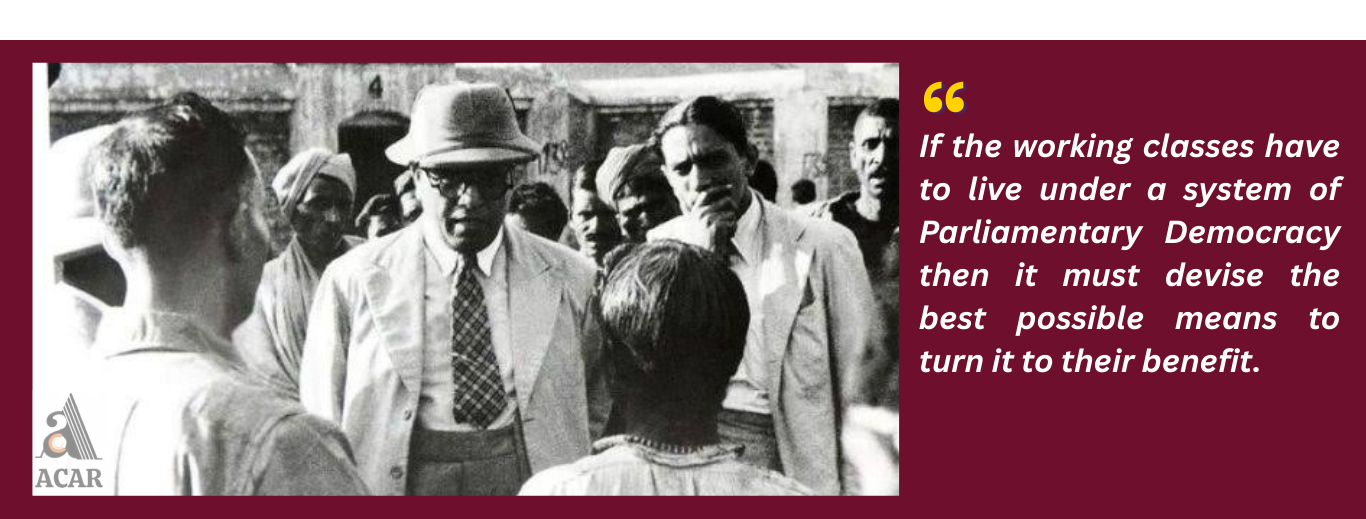
The new Labour Codes are portrayed as a landmark, by the Industry and federations applauding it for legal “uniformity” and “simplification” for ease of doing business. However, when compared to Babasaheb Ambedkar’s labor vision as a Labour Member (1942–46), fall short in crucial ways as Valerian Rodrigues bonds it with Deweyan Industrial democracy, Fabian welfare and Buddhist ethics of equality (2024). Babasaheb Ambedkar sought more than just uniform legislation, Industrial democracy, social security, and a permanent, tripartite machinery to make labor a partner in national governance rather than just a regulated subject. In contrast, the new Labour Codes allows industry to fire upto 300 workers, restrain strikes, ignore unions and put workforce for 12 hour shifts.
Labour Code vs Conference
Ambedkar’s interventions in labor policy, as exemplified in tenth volume of Babasaheb Ambedkar’s writings and speeches focused on three interconnected objectives: uniform labor laws that guarantee workers, regardless of region, shared a minimum level of rights and protections, a central, precise method for resolving labor disputes, and a platform for all of India to discuss “all matters relating to employers and employees that are of national importance,” institutionalized in the form of a permanent Labour Conference and a Standing Labour (Advisory) Committee. The Labour Conference and Standing Committee were designed as permanent, representative bodies to shape policy, examine legislation, and incorporate labor’s voice into everyday industrial governance. They bring together the Centre, provinces, employers, and employees. As a result, his concept of “uniformity” was substantive: a uniform and high standard of protection, social security, and participation rather than just a single statute.
Parliament of Labor
It is undeniable that the Code provides formal consolidation. However, critical examinations of the Code reveal that fewer workers are protected during layoffs, retrenchment, or closure. Collective action is made more difficult by stricter strike conditions and notice requirements. Employer flexibility is increased, but job security is decreased, and fixed-term employments are promoted. In general, the Code tends to solidify industrial relations, shifting dispute resolution from tripartite negotiation and collective bargaining to procedural, legalistic processes. Formal uniformity is provided by the Code, but not substance. As a result, protection becomes uneven, especially for workers in companies that are only slightly above the new size limits. Babasaheb Ambedkar envisioned a permanent Labour Conference and a Standing Labour Advisory Committee as the central pillars of industrial governance. However, there is no such national tripartite platform created by the Codes. While broader consultative forums remain ad hoc and outside the Code’s core design, dialogue is largely restricted to establishment-level works committees or grievance bodies. Simply put, the “parliament of labor” that Babasaheb Ambedkar envisioned is not institutionalized by the consolidated Codes. Until then, the Labour Codes will continue to be a technically unified code that falls short of Ambedkar’s vision of a transformative labor democracy.
Division of labourers
The labor issue was inseparable from Babasaheb Ambedkar’s political journey from Independent Labour Party to Scheduled Caste Federation, as evident in the name and manifesto. Babasaheb Ambedkar saw labor rights as the foundation for creating a just and modern India, and envisioned an industrial order in which worker dignity, fair participation, and social security were rights guaranteed by the State. Babasaheb Ambedkar warned labour to, “dissociate from communal or capitalistic political parties such as Hindu Mahasabha or the Congress”, as their politics seen today has moved away from liberating labour. However, Ambedkarite politics must bring labour back to the center. We cannot fight caste and ignore labour exploitation. The defence of labour has largely been outsourced to trade unions and left-led groups. Let Mahaparinirvan Day remind us that Babasaheb Ambedkar’s labour revolution remains unfinished, let’s continue the fight he began.
6th December 2025